Social Icons

Showing posts with label Famous Ukrainians. Show all posts

Monday, November 28, 2016

Princess Olga/ Part One

Princess Olga (~ 890-11 July 969) – The great Princess Kiev, the wife of the Grand Duke Igor Ryurikovich after whose death, ruled Russia behind the early childhood of their son Svyatoslav. The name of the Princess Olga is in a source of the Russian history, and is connected with the greatest events of the basis of the first dynasty, with the first statement in Russia of Christianity and striking traits of the western civilization. After death the simple people called it cunning, church – the Saint, history - wise.


    According to the earliest Old Russian chronicle "Story of Temporary Years", the Saint grand duchess Olga equal to the apostles, in a sacred baptism Elena, came from a family of Gostomysl on the advice of which Varangians were called to reign in Novgorod, was born in the Pskov earth, in the village of Vybuty, in a pagan family from a dynasty of princes Izborsky.

In 903 she became the spouse of the grand duke Kiev Igor. After murder of the prince in 945 by the risen Drevlyans, the widow who didn't wish to marry, assigned to herself a burden of the state service at the three-year-old son Svyatoslav. The grand duchess became history as a great sozidatelnitsa of the state life and culture of Kievan Rus'.

In 954 the princess Olga for the purpose of a religious pilgrimage and diplomatic mission went to Tsargrad where with honor it was accepted by the emperor Konstantin VII Bagryanorodny. It was struck by greatness of Christian temples and the shrines collected in them.


    The sacrament of baptism over it was made by the Patriarch Constantinople Feofilakt, and the emperor became the godfather. The name to the Russian princess was named in honor of the Saint queen Elena who found the Lord's Cross. The patriarch blessed the novokreshchenny princess with the cross which is cut out from an integral piece of the Lord's Life-giving tree with an inscription: "Be updated the Russian land by the Sacred Cross, it was accepted by Olga, the blessed princess".

Upon return from Byzantium Olga jealously bore a Christian christian message to pagans, began to erect the first Christian temples: for the sake of Saint Nikolay over a tomb of the first Kiev Christian prince Askold and Sacred Sofia in Kiev over a tomb of the prince Deere, the temple of the Annunciation in Vitebsk, - on the river bank Great she saw the temple for the sake of the Holy and Zhivonachalny Trinity in Pskov for which place, according to the chronicler, was specified by it from above "Luchem of the Trisiyatelny Deity" descending from the sky "three presvetlykh of a beam".


The Saint princess Olga in 969 on July 11 passed away (the Art. style), having bequeathed openly to make burial it Christianly. Its incorruptible relics were based in tithe church in Kiev.

Marriage with the prince Igor
and beginning of government of the princess Olga

    According to "The story of temporary years" Prophetic Oleg married Igor Ryurikovich who began to govern independently since 912 to Olga in 903 that is when she already was 12 years old. This date is called in question as, according to the Ipatyevsky list of same "Story", their son Svyatoslav was born only in 942.

The legend calls Olga's homeland the village of Vybuty near Pskov, up the river Great. Olga's Saint narrates life that here her meeting with future spouse for the first time took place.

The young prince hunted "in the field of Pskov" and, wishing to get over through the river Great, saw "certain floating in the boat" and called up him to the coast. Having sailed from the coast in the boat, the prince found out that it the girl of surprising beauty is lucky.

Revenge of the princess Olga 

      Drevlyans after Igor's murder sent to his widow Olga of matchmakers to call her in marriage for the prince Mal. The princess consistently dealt shortly with elders of Drevlyans, and then resulted the people of Drevlyans in humility. The Old Russian chronicler in detail states Olga's revenge for the death of the husband:

1st revenge of the princess Olga: Matchmakers, 20 Drevlyans, arrived in a castle which Kiev residents carried and was thrown into a deep hole outside by Olga's towers. Matchmakers ambassadors were dug alive together with a castle.
And, having inclined to a hole, Olga asked them: Whether "Honor is good to you?". They answered: "Is more bitter to us than Igorevy death". Also enjoined to fill up them live; also filled up them.

2nd revenge: Olga asked to send for respect for it new ambassadors from the best husbands, as with hunting was executed by Drevlyans. The embassy from notable Drevlyans was burned in a bath while those washed, preparing for a meeting with the princess.

The princess Olga meets a body of the prince Igor
"The princess Olga meets a body of the prince Igor" V. I. Surikov's Sketch, 1915


3rd revenge: The princess with a small team arrived to lands of Drevlyans that on custom to celebrate a funeral feast on the husband's grave. Having hocused during the funeral feast of Drevlyans, Olga ordered to cut them. The chronicle reports about 5 thousand interrupted Drevlyans.

4th revenge: In 946 Olga contacted with army in a campaign Drevlyans. According to the Novgorod First chronicle the Kiev team won against Drevlyans fight. Olga walked on the Drevlyansky earth, established tributes and taxes then returned to Kiev. In PVL the chronicler made insert in the text of the Initial arch about a siege of the drevlyansky capital of Iskorostenya. On PVL after an unsuccessful siege during the summer Olga burned the city by means of birds to whose legs ordered to tie the lit tow with sulfur. A part of defenders Iskorostenya were killed, the others obeyed. The similar legend of burning of the city by means of birds is stated also by Sakson Grammatik (the 12th century) in its compilation of oral Danish legends about feats of Vikings and skaldy by Snorri Sturluson.

After punishment of Drevlyans Olga began to rule Kievan Rus' to Svyatoslav's majority, but also after that she remained the actual governor as her son the most part of time was absent in military campaigns.


Saturday, November 26, 2016

Vladimir Havkin is an outstanding microbiologist who the first invented a vaccine against cholera and plague

Vladimir Aronovich Havkin was born in 1860 in Berdyansk. Since the childhood at the boy tendency to natural sciences was shown. After the termination of the Berdyansk gymnasium, Vladimir entered the Odessa university. The outstanding scientist-microbiologist Ilya Mechnikov under the influence of whom Vladimir Havkin became interested in zoology of protozoa was his teacher.

Havkin was very gifted and differed in improbable diligence, but at the same time he was a participant of the political organization which opposed the Jewish riots in Odessa. For participation in this political Havkin's union expelled from university twice and subjected to arrests.

In 1884 Vladimir Havkin graduated from the university external, defended the dissertation and received an academic degree of the candidate of zoology. Because of the Jewish origin the young scientist had no opportunity to conduct scientific research in the homeland, and he decided to leave for abroad.

At first Vladimir Havkin went to Switzerland, and then to Lausanne where entered a position of the privatdozent of the Lausanne university. In 1889 Vladimir left to Paris. The outstanding scientist-microbiologist Ilya Mechnikov helped to find to him work of the librarian, and then a position of the research associate in world famous Pasterovsky institute. At that time Louis Pasteur already created vaccines against rage and anthrax.

At the end of the 19th century in the world deadly diseases stormed: cholera and plague. Vladimir Havkin was fond of development of an anticholera vaccine and set for himself the big object - to find a way of rescue of mankind from this serious illness. He made experiments on guinea pigs and rabbits, entering it microbes of diseases to calculate a dose, necessary for prevention. By 1892 Vladimir Havkin managed to create the first effective vaccine against cholera and proved in himself its safety for the person.

However the French authorities didn't hurry to enter the vaccine invented by the foreigner and the Russian Empire was indifferent to opening of the scientist too. And here the British government became interested in opening and allowed Vladimir Havkin to test a vaccine in India where at this time cholera epidemic raged, took away hundreds of thousands of human lives.

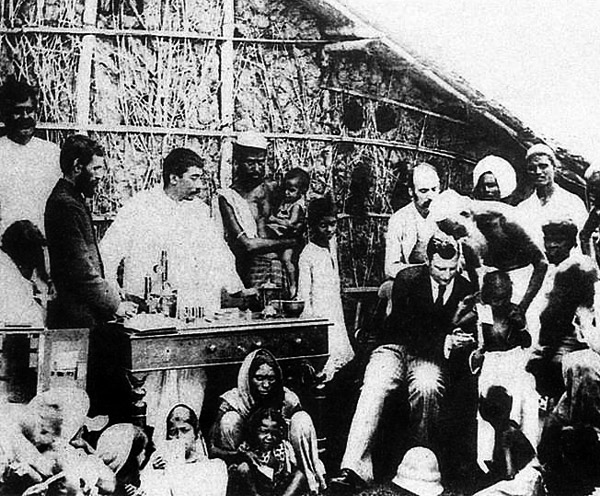
1893 Vladimir Havkin went to Calcutta in the status of the state bacteriologist of the British crown. Very quickly in the tent town the scientist arranged production of the vaccine and mass vaccination of the population began. Havkin personally participated in vaccination more than 42 000 people. Cholera seemed and began to recede, mortality in the areas captured by cholera epidemic decreased in tens of times. Inoculations of a vaccine of Havkin became after that mass and are applied in the improved look still.

And the trouble - plague which epidemic struck in 1896 the second-large city of Bombay and its vicinities came for cholera to India even more terrible. From Calcutta Vladimir Havkin transferred the base to Bombay where in three months made an antiplague vaccine, and on January 10, 1897 was already influenced by it. Within several years the outstanding microbiologist directly participated in vaccination of the population.

In total in India more than 4 million people were vaccinated. The antiplague vaccine of Havkin gained distribution around the world. In forty years were imparted and more than thirty five million people were saved from death. The outstanding scientist was appointed the chief bacteriologist of India and the director of the Bombay antiplague laboratory. Later this laboratory was transformed to Havkin's Institute. The state mail of India released a stamp with a portrait of the outstanding scientist. In total Vladimir Havkin lived in India twenty two years.

In 1897 the Queen Victoria awarded Vladimir Havkin with one of the highest awards of the British Empire. The scientist from Berdyansk was elected by the honorary member of many scientific organizations and academies of the countries of Europe and Asia. In 1909 the Parisian academy noted an award a huge contribution of Havkin to development of medicine.

In 1915 Vladimir Havkin returned from India to Europe. In the second half of the 20th years he lodged in Lausanne, on the bank of Lake Geneva. In Lausanne Vladimir addressed belief of parents and began to visit a synagogue. In the fall 1927 visited Odessa. One year prior to death Havkin bequeathed 500000 dollars on creation of fund for promotion of young talents at the Jewish religious schools of Eastern Europe. Vladimir Havkin's fund exists still.

The outstanding scientist from Berdyansk died in 1930 in Lausanne, Switzerland. In India Havkin's death became in the afternoon ​​ deep national mourning. It was the real genius who could resist to fatal diseases and saved mankind from cholera and plague.

source - http://www.discoverukraine.com.ua

Monday, November 21, 2016

Ivan Firtsak - the strongest person to the first half of the XX century

Ivan Firtsak - the Ukrainian nugget about which Europeans made legends. In the people he was called Ivan Sila, and the whole world remembered its circus nickname - Crotone.

About the Transcarpathian athlete spoke since the childhood. Will hear that the young man himself harnessed himself in a plow, will see how on shoulders carries a calf. Parents understood that at yourself you shouldn't hold the son and decided to send Ivan to the Czech Republic.


At first was to it not with pleasure and there weren't enough stars from the sky it. Ivan Firtsak worked at the plant, the loader at the station, didn't hear yet praise of the wandering athlete who assured that he will win against everyone. "Why not to try?", - the Ukrainian Thought. He tried and won a victory after which trainers noticed his talent. In 23 years Ivan Firtsak became the champion in weightlifting, won against 70 times kettlebell sport competitions. But the sport didn't bring big earnings, and the Ukrainian athlete decided to try the force in circus. A palm Ivan beat an oak board 20-centimeter nails, and then teeth pulled out them. Curved heart from metal fittings and many other interesting tricks. Came to look at this show also the president of Czechoslovakia, and also the queen of Great Britain. She wanted to see the Ukrainian athlete on a ring with the world champion in a super heavyweight John Jackson. But the idea was unsuccessful as Ivan didn't calculate the forces and broke to the boxer a thorax. The blow was such powerful that the boxing glove burst. After a duel Jackson didn't sustain and jumped out of a window of the multi-storey building. After this case Ivan Firtsak was attacked by John Jackson's supporters who injured the athlete's head therefore to it diagnosed an open fracture of a skull. Doctors were forced to implant a gold plate into the injured skull bone. Two months the athlete went with the bandaged head, and further acted in a wig. As compensation and Ivan Firtsak's recognition the queen of England presented it a champion belt, cuffs and the helmet decorated with diamonds and the relief image of lions.

With "Gertsfert-circus" Ivan Firtsak visited the half-world, having captivated the skill Hungary, Bulgaria, Greece, Romania, France, Denmark, the Netherlands, Poland, Canada, the USA and many other countries. Generally acted in 64 countries of the world and скизь its performances accepted with an applause.

Triumphal historical the performance took place in the USA where Ivan of Sil struck Americans with the trick when laid down on the earth, and the car moved a wheel through his throat. This performance stunned audience, and the management of the plant Ford for commission of this improbable trick presented the Ukrainian personalized car. By the way, when Ivan Firtsak returned home, the local administration wanted to confiscate the car, but Ivan took a sledge hammer and broke the American gift. He was punished for such act: he was put in prison and beaten.

Ivan Firtsak of 70 times won kettlebell sport competitions, became the winner of a beauty contest of a body in Paris. On its phenomenal force, tricks and unique records the world community called Firtsak by the name of the antique hero of Crotone. In 1928 it was recognized as the strongest person of the planet. Nobody can still repeat some power tricks of Ivan Firtsaka-Crotone.

Ivan Firtsak broke off the 10-year contract with circus of earlier stipulated term and through court paid to the owner big compensation - 100 thousand. Kroner. Returned to the native village in the late thirties where it was waited by a big family - Ivan was a father of 8 children. On bitkivshchin, after establishment of the Soviet power, People's Commissariat for Internal Affairs confiscated all its awards, distinctions and even photos from legendary Crotone. In default of a phenomenon of Ivan Sila the destiny of his son played a significant role Soviet period: 18-year-old Ivan Firtsak Jr. in post-war years was condemned on a trumped-up case in belonging to OUN for 25 years of camps from which he nearly 8 stayed. It was great hope for the father, always acted with it in couple and was a champion of the USSR in boxing in the first post-war years.

It was necessary to earn a living of a big family besides by performances. Ivan of Sil Ezdil on villages, blew the horn and called in local club of everyone. An entrance fee - 20 kopeks. Though was not to young people, but also bent fittings further, pulled cars and lifted at the same time several people. Subsequently Ivan Firtsak founded Transcarpathian circus school and school of power arts. His many pupils received champion titles in weightlifting.

The gold plate which demanded replacement became implanted to one of causes of death of Ivan Firtsak. At the time of the Soviet Union there was no opportunity to go abroad for its planned replacement therefore the wound under a plate began to rot. The doctor who regularly came to the athlete with Irshava couldn't make anything. Ivan Firtsak in the native village of the Squirrel died on November 10, 1970. A funeral of the athlete was populous - to say goodbye to Crotone there arrived many athletes.

Friday, November 18, 2016

King Danilo Galizcy

Times of government of Daniil Galitsky are time of the most economic and cultural rise and political influence of the Galitsko-Volynsky state, became the largest state of Europe.


In the West city of Galich 1201 in a family of the prince Roman Bolshy the eldest son Daniil was born, will become future governor of one of the largest states of Europe of that time.

Daniil's father is Roman Mstislavich, the outstanding personality from a dynasty of Ryurik dynasty, was read by contemporaries the most powerful of all Russian princes of the end of XII-of the beginning of the 13th century for what it was nicknamed "By Veliky the duke Kiev". Also the patriarch of a local ruling kind Romanovichey was a founder of the Galitsko-Volynsky principality. About Daniil's mother there aren't enough data and the confirmed facts, in it is historical sources anywhere the name of the wife of Roman Mstislavich isn't told. Chroniclers called it only by the name of the husband - "The Grand Duchess Romanova". Some historians read that Vasilka Romanovichey the second wife of Roman Veliky - Efrosinya-Anna, coming from an ancient noble family was mother of princes of Daniil and and was a daughter of the Byzantine emperor Isaak IYA Angel.

In four years, after Daniil's birth, Roman Bolshoy died and the princess Anna with juvenile sons moved from Galich to Vladimir on Volhynia where her husband was buried. In 1206 the widow Efrosinya-Anna together with the younger son prince Vasily went to Krakow, and sent high Daniil to the yard of the Hungarian king for 6 years. As juvenile princes Daniil and Vasylko couldn't hold the power in the hands, instead of them till 1215 their mother governs. When the prince Daniil reached the 18 anniversary and began to rule in Vladimir independently, then the princess Efrosiniya-Anna left a throne and went to the monastery.

Roman Veliky's death caused quarrels for the earth between princes and boyars, the Polish and Hungarian feudal lords who afterwards and captured Galichina. But Daniil and Vasylko weren't going to be reconciled with it and afterwards began the long fight for fatherly inheritance. "To gather" Roman Veliky's possession, at first Volhynia, and then the city of Galich and a part of Galicia, was required to the prince Daniil Galitsky 40 years.

Only in 1245 after the victory over the Polish-Hungarian troops under Yaroslav, Daniil Romanovich finally returned himself all Galicia. He built the cities locks and fortresses in Kamenets-Litovsky, Brest, Bilan, Kamentsa Podolsk, Hotin, delivered the posadnik and military garrisons there. These cities defined boundaries of the state, served as a powerful barrier on the way of the Tatar and other conquerors which so never and could capture some of them. Daniil Romanovich was a founder of several cities, one of them called by the name of the son - Lev.

To again created cities invited handicraftsmen and merchants from Poland, Germany, other lands of Russia. They had an opportunity to work freely in favor of the state under Danila Romanovich's tenure of office. The Galitsko-volynsky state turned into the country which exported not only wax and fur, and began to take out craft products to Europe. Through the city of Dorogichin protected by Danila from encroachments of crusaders, local merchants had an output to one of the greatest shopping centers of that time - the Polish city of Torun. Danila can be read the first domestic statesman who embodied the program of progressive economic development of the lands. Thanks to wise state policy Danila Romanovich managed to save the state from destruction by Mongol Tatars. It actually didn't obey the authorities of the Golden Horde.

In December, 1253 (January, 1254) in the city of Dorogochin_ the remarkable historical event took place. The Pope Innokenti IV provided to Danila Galitskoy a royal title. The papal legate spread Danila Romanovich which accepted royal difference "from all the bishops", emphasizing with it that not only he is crowned, and Russia.

The state which was headed by the king Danila embraced the territory almost in 200 stings of sq.km and enveloped the modern Volynsk, Lviv, Ivano-Frankivsk, Ternopil, Chernivtsi, to Hmelnitsk, the considerable parts Rivne, Vinnytsia, Odessa, Kiev and some other areas of Ukraine, a part of the territories of the modern of Belarus, Poland, Moldova. The king Danila was an uncommon identity, the influential politician, the dexterous commander and the wonderful organizer of the state life.

An absolute master of the Galitsko-volynsky state Danila Galitskaya was during 1245-1264. In the summer in 1264 as the chronicler reports, Danila "fell. in a disease big" also died. The Saint Bogorodits_ in Holm's city is buried in church. In the chronicle it is marked: "this king Danila [was] the prince kind, brave and wise which constructed kitchen gardens мног і, and delivered churches, and decorated them with various jewelry, and bratolyubstey he shone was with the brother the Cornflower. This Danila was the second after Solomon".

www.discoverukraine.com.ua source
 
Blogger Templates